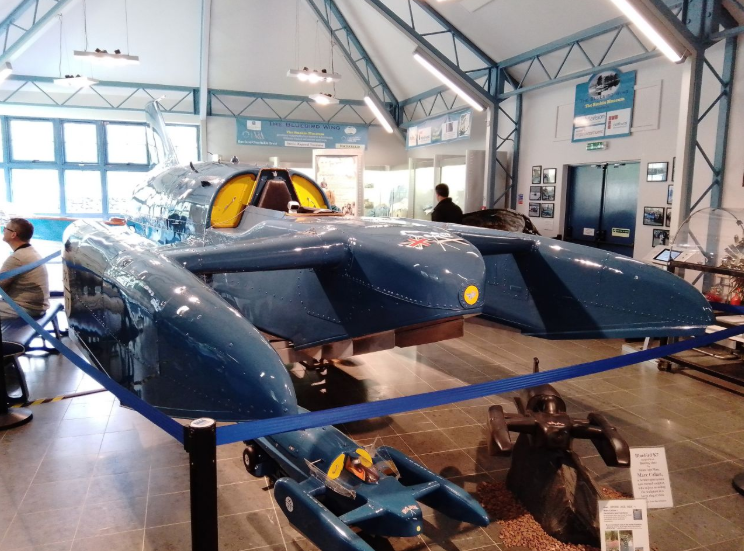
Our Heritage – Bluebird K7
Issac Jackson, born 1857, moved to Glossop in 1879 from Hyde where he had worked with his father Horace who was a saddler. Horace was frustrated by the poor quality of fasteners available for his business, seeing this Issac, the innovative and industrious young man set about designing and manufacturing fasteners of a higher quality, primarily in support of his father’s business.
Being the late 1800’s and the peak of the industrial revolution, the modern factory began to take shape in the way that which we know it today. Large purpose built buildings many floors high with rows of machines. Machinery wasn’t powered by individual motors as it is today, the factory would be equipped with one large steam engine or a water wheel, power from this would be distributed throughout the factory by a system of overhead line shafts equipped with pulleys, from the pulley power would be transmitted down to each machine by a flexible canvas or leather drive belt.
Issac’s fasteners were ideal for making and repairing these drive belts and he designed and patented a myriad of different types for a myriad of different applications.
In 1905 Issac took occupancy of the derelict Starkies mill in Old Glossop where he equipped it with the ‘Finest English and American machinery’.
With the onset of world war one in 1914, Issac Jackson and sons was turned over to the production of war materials. One item in particular is worthy of note, the 106 artillery fuse.
Prior to the 106, contact fuses were unreliable, only detonating after hitting something hard like a wall or firm ground. The 106 fuse was much more sensitive and would detonate against soft earth and barbed wire. The internals of this fuse consisted of many highly engineered parts and it is these which Issac Jackson was commissioned to make. Being cast, the items in question were relatively slow to manufacture, forever the inventor Issac used his skills and knowledge of forging to speed up production at which he was very successful.
As a result Issac became very wealthy, being a philanthropist, much of the money was donated to the town of Glossop, the market ground and town hall were purchased and donated to the town, Jacksons Buildings, Old Glossop church both benefitted from Jacksons money.
Issac died in 1922 and running of the company was taken over by his wife Harriet, an astute business women in her own right. Harriet ran the company until her death in 1938.
The business continued up till the 1970’s forging parts for the mining, automotive and agriculture industries, around this time the aerospace division was set up, making forged parts for the aircraft industry. The aerospace division was a small department run alongside the main part of Issac Jackson Fasteners. In 1982 amongst a recession and difficult trading conditions the company ceased trading, opening a short while later as two distinct companies, the conveyor belt fasteners being made under the name ‘Jackson Fasteners’ and the aircraft parts under the name ‘Ravenstone’. Ravenstone continued to use the latter J as its trademark, in honor of its founding father, and this is where our story begins proper. In the early 1980’s Ravenstone supplied into the local aircraft manufacturers, BAE Woodford, Chaderton, Brough, and the distribution market. In the late 1990’s Jackson Fasteners were bought out by the American company Flexco and our new landlord wanted the space Ravenstone occupied, in 2000 Ravenstone changed ownership to the Lentern Group and became ‘AF Fasteners’ moving premises to a new industrial unit at Glossop Brook Business Park. As the BAE sites have closed over the years and the aircraft they made have become obsolete AF have diversified their product portfolio to align with contemporary aircraft production, adapting the parts it produces to meet the needs of the aircraft industry at the time.
As our founding father and mother would have wished, innovation, invention and perseverance are at the heart of our business and drive us forward as a company, we proudly carry the initial J of Issac and Harriet as our trademark, with good reason.